2026
|
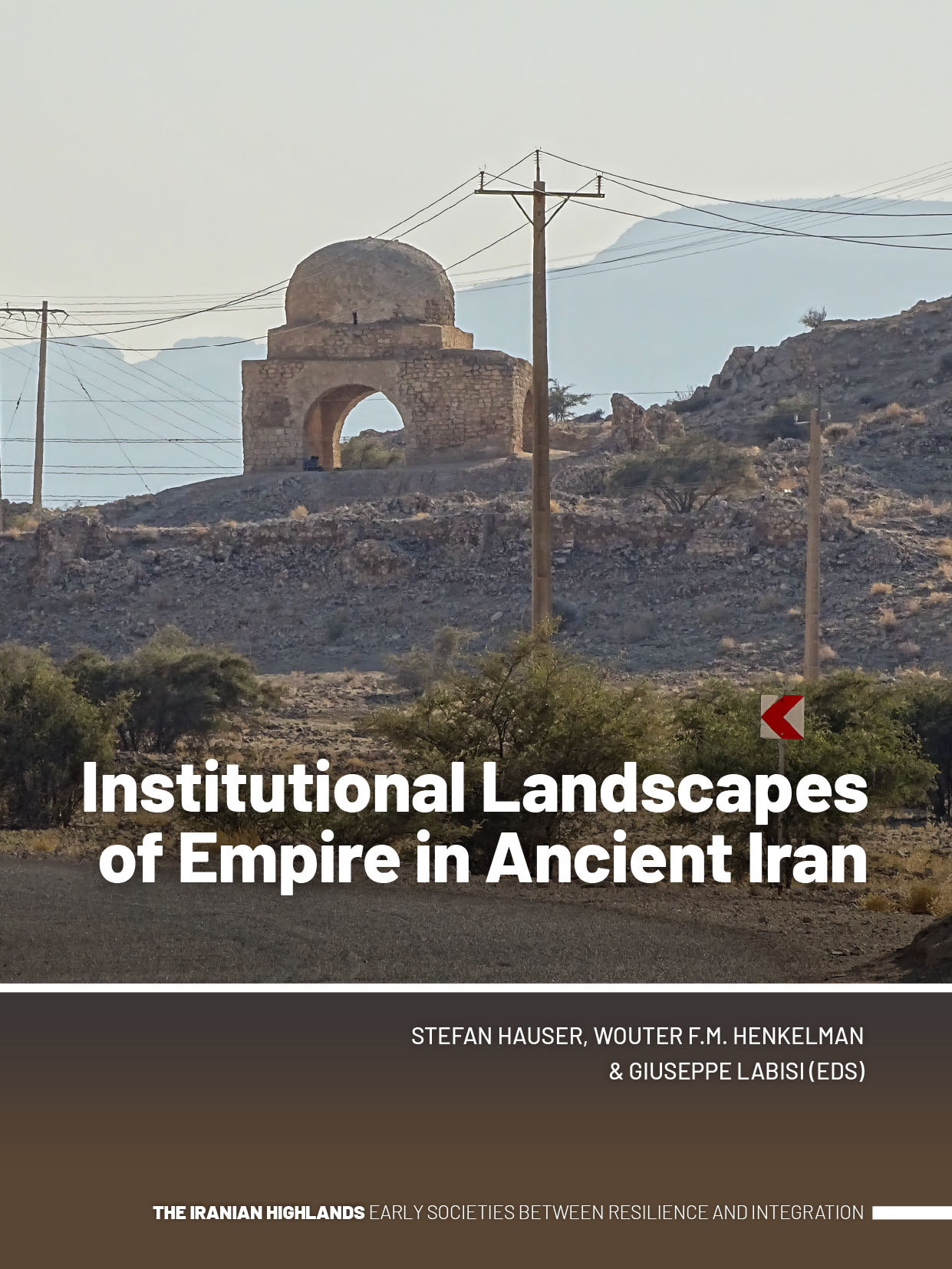 | Parsa, Sarvenaz: Institutions, location, and architecture: Transformation of landscape and its meaning through the construction of chahartaq structures in ancient Iran. In: Hauser, Stefan R.; Henkelman, Wouter F. M.; Labisi, Giuseppe (Ed.): Sidestone, Institutional Landscapes of Empire in Ancient Iran, 2026. @inbook{nokey,
title = {Institutions, location, and architecture: Transformation of landscape and its meaning through the construction of chahartaq structures in ancient Iran},
author = {Sarvenaz Parsa},
editor = {Stefan R. Hauser and Wouter F.M. Henkelman and Giuseppe Labisi},
url = {https://www.sidestone.com/books/institutional-landscapes-of-empire-in-ancient-iran},
doi = {https://doi.org/10.59641/z4c0w1x2y3},
year = {2026},
date = {2026-01-01},
urldate = {2026-01-01},
publisher = {Sidestone},
edition = {Institutional Landscapes of Empire in Ancient Iran},
series = {The Iranian Highlands. Early Societies between Resilience and Integration},
keywords = {Architecture, Institutions, Landscape, SPP, Workshop},
pubstate = {published},
tppubtype = {inbook}
}
|
2023
|
 | Fuchs, Christian; Ajorloo, Bahram: The Rabʿ-e Rashīdī Site in Tabriz (Iran) and its Architectural Remains. In: Proceedings of the 12th International Congress on the Archeology of the Ancient Near East, pp. 851-865, Harrassowitz Verlag - Wiesbaden, 2023. @inproceedings{nokey,
title = {The Rabʿ-e Rashīdī Site in Tabriz (Iran) and its Architectural Remains},
author = {Christian Fuchs and Bahram Ajorloo},
url = {https://www.harrassowitz-verlag.de/titel_7228.ahtml},
doi = {10.13173/9783447118736},
year = {2023},
date = {2023-01-01},
urldate = {2023-01-01},
booktitle = {Proceedings of the 12th International Congress on the Archeology of the Ancient Near East},
volume = {2},
pages = {851-865},
publisher = {Harrassowitz Verlag - Wiesbaden},
abstract = {The Rabʿ-e Rashīdī complex was a charity foundation in the city of Tabriz, Iran. Its founder Rashīdoddīn Fażlollāh-e Hamadānī was vizier under the Ilkhanid rulers Ghāzān Khān (1295-1304 CE) and Öljeitü (1304-1316). The present ruins were understood to date back to the late 16th / early 17th century. Yet, the recent investigations were able to prove that these structures are multi-phased buildings constructed between the early 14th and the early 17 th century. The finds enable us to uncover the history and the development of the site during the periods following the destruction of the Ilkhanid complex.},
keywords = {Architecture, Islamic era, Mongols},
pubstate = {published},
tppubtype = {inproceedings}
}
The Rabʿ-e Rashīdī complex was a charity foundation in the city of Tabriz, Iran. Its founder Rashīdoddīn Fażlollāh-e Hamadānī was vizier under the Ilkhanid rulers Ghāzān Khān (1295-1304 CE) and Öljeitü (1304-1316). The present ruins were understood to date back to the late 16th / early 17th century. Yet, the recent investigations were able to prove that these structures are multi-phased buildings constructed between the early 14th and the early 17 th century. The finds enable us to uncover the history and the development of the site during the periods following the destruction of the Ilkhanid complex. |
| Lorain, Thomas; Ajorloo, Bahram; Korn, Lorenz: Preliminary Results of the Iranian-German Archaeological Campaign at the Rabʿ-i Rashīdī Complex in Tabriz. In: Proceedings of the International Congress on the Archaeology of the Ancient Near East, pp. 867-877, Harrassowitz Verlag - Wiesbaden, 2023. @inproceedings{nokey,
title = {Preliminary Results of the Iranian-German Archaeological Campaign at the Rabʿ-i Rashīdī Complex in Tabriz},
author = {Thomas Lorain and Bahram Ajorloo and Lorenz Korn},
url = {https://www.harrassowitz-verlag.de/isbn_9783447119030.ahtml},
doi = {https://www.doi.org/10.13173/9783447119030},
year = {2023},
date = {2023-01-01},
booktitle = {Proceedings of the International Congress on the Archaeology of the Ancient Near East},
volume = {2},
pages = {867-877},
publisher = {Harrassowitz Verlag - Wiesbaden},
abstract = {After a geophysical survey of the site, the Tabriz Islamic Art University, the Sāzmān-i Mīrāth-i Farhangī of Eastern Azerbaijan and the University of Bamberg worked again at the archaeological site of Rabʿ-i Rashīdī for a second joint excavation campaign in September 2019. The present paper aims to introduce the preliminary results of the work carried out by the Iranian-German team in two different areas of the site (trenches XII and XIII). Among the evidence uncovered at the site, traces of Ilkhanid building activities as well as their destruction and the re-use of some areas in later phases are of particular significance.},
keywords = {Architecture, Ilkhanate, Islamic era},
pubstate = {published},
tppubtype = {inproceedings}
}
After a geophysical survey of the site, the Tabriz Islamic Art University, the Sāzmān-i Mīrāth-i Farhangī of Eastern Azerbaijan and the University of Bamberg worked again at the archaeological site of Rabʿ-i Rashīdī for a second joint excavation campaign in September 2019. The present paper aims to introduce the preliminary results of the work carried out by the Iranian-German team in two different areas of the site (trenches XII and XIII). Among the evidence uncovered at the site, traces of Ilkhanid building activities as well as their destruction and the re-use of some areas in later phases are of particular significance. |
2022
|
 | Korn, Lorenz; Luib, Anna: Das Rabʿ-e Rashidi in Tabriz, Iran: Archäologische und bauhistorische Prospektionen eines mittelalterlichen Stadtteils. In: Rütemik, Tobias Arera; Bellendorf, Paul; Breitling, Stefan; Drewello, Rainer; Hess, Mona; Vinken, Gerhard (Ed.): Kompetenzzentrum Denkmalwissenschaften und Denkmaltechnologien 2018 – 2020, vol. 2, pp. 28-31, University of Bamberg Press, Bamberg, 2022, ISBN: 978-3-86309-864-3. @inbook{nokey,
title = {Das Rabʿ-e Rashidi in Tabriz, Iran: Archäologische und bauhistorische Prospektionen eines mittelalterlichen Stadtteils},
author = {Lorenz Korn and Anna Luib},
editor = {Tobias Arera Rütemik and Paul Bellendorf and Stefan Breitling and Rainer Drewello and Mona Hess and Gerhard Vinken},
doi = {https://doi.org/10.20378/irb-54270},
isbn = {978-3-86309-864-3},
year = {2022},
date = {2022-01-01},
urldate = {2022-01-01},
booktitle = {Kompetenzzentrum Denkmalwissenschaften und Denkmaltechnologien 2018 – 2020},
issuetitle = {Berichte des KDWT},
volume = {2},
pages = {28-31},
publisher = {University of Bamberg Press},
address = {Bamberg},
keywords = {Architecture, Ilkhanate, Mongols},
pubstate = {published},
tppubtype = {inbook}
}
|
 | Labisi, Guiseppe: Squinches and Semi-domes Between the Late Sasanian and Early Islamic Periods. In: Iran: Journal of the British Institute of Persian Studies, iss. 28, no. 2, pp. 236-49, 2022. @article{nokey,
title = {Squinches and Semi-domes Between the Late Sasanian and Early Islamic Periods},
author = {Guiseppe Labisi},
doi = {https://doi.org/10.1080/05786967.2019.1633241},
year = {2022},
date = {2022-00-00},
urldate = {2022-00-00},
journal = {Iran: Journal of the British Institute of Persian Studies},
number = {2},
issue = {28},
pages = {236-49},
abstract = {The aim of this paper is to present a first attempt at a comprehensive classification of squinches related to semi-domes, in Persian kāna pūsh, in Greater Syria, Mesopotamia and Iran between the late Sasanian and early Islamic periods. This feature is a characteristic of the Persian architectural tradition: all the preserved examples are in buildings of considerable importance (most are related to the architecture of the élites) and demonstrate a typological evolution. Furthermore, their origin can also be backdated to between the late Sasanian and early Islamic periods.},
keywords = {Architecture, Islamic era, Sasanian, Social, social relations, Syria},
pubstate = {published},
tppubtype = {article}
}
The aim of this paper is to present a first attempt at a comprehensive classification of squinches related to semi-domes, in Persian kāna pūsh, in Greater Syria, Mesopotamia and Iran between the late Sasanian and early Islamic periods. This feature is a characteristic of the Persian architectural tradition: all the preserved examples are in buildings of considerable importance (most are related to the architecture of the élites) and demonstrate a typological evolution. Furthermore, their origin can also be backdated to between the late Sasanian and early Islamic periods. |
2021
|
| Korn, Lorenz; Heidenreich, Anja: The Site of Rabʿ-i Rashidi, Tabriz: Goals and Beginnings of the Iranian-German Research Project. In: Proceedings of the First International Conference on the Commemoration of Rashid al-Din Fazl-Allah Hamadani (University of Tabriz, March 2021), pp. 295-314, University of Tabriz Press, 2021. @inbook{nokey,
title = {The Site of Rabʿ-i Rashidi, Tabriz: Goals and Beginnings of the Iranian-German Research Project},
author = {Lorenz Korn and Anja Heidenreich},
year = {2021},
date = {2021-00-00},
urldate = {2021-00-00},
booktitle = {Proceedings of the First International Conference on the Commemoration of Rashid al-Din Fazl-Allah Hamadani (University of Tabriz, March 2021)},
pages = {295-314},
publisher = {University of Tabriz Press},
keywords = {Administration, Architecture, Ilkhanate, Institutions, Mongols},
pubstate = {published},
tppubtype = {inbook}
}
|
1996
|
| Kulke, Holger: Large pigeon towers in the province of Esfahan (Iran): endangered traditional adobe buildings. In: Trialog, vol. 51, no. 4, pp. 30-35, 1996. @article{nokey,
title = {Large pigeon towers in the province of Esfahan (Iran): endangered traditional adobe buildings},
author = {Holger Kulke
},
year = {1996},
date = {1996-00-00},
urldate = {1996-00-00},
journal = {Trialog},
volume = {51},
number = {4},
pages = {30-35},
publisher = {TRIALOG e. V.},
keywords = {Architecture},
pubstate = {published},
tppubtype = {article}
}
|
1980
|
| Kleiss, Wolfram: Europäische Befestigungsarchitektur in Iran vom 16. bis zum 19. Jahrhundert. In: Archäologische Mitteilungen aus Iran, vol. 13, pp. 167-178, 1980. @article{nokey,
title = {Europäische Befestigungsarchitektur in Iran vom 16. bis zum 19. Jahrhundert},
author = {Wolfram Kleiss
},
year = {1980},
date = {1980-00-00},
urldate = {1980-00-00},
journal = {Archäologische Mitteilungen aus Iran},
volume = {13},
pages = {167-178},
publisher = {Reimer},
keywords = {Architecture, Fortification},
pubstate = {published},
tppubtype = {article}
}
|
1978
|
| Bahadori, Mehdi N.: Passive Cooling Systems in Iranian Architecture. In: Scientific American, vol. 238, no. 2, pp. 144-155, 1978. @article{nokey,
title = {Passive Cooling Systems in Iranian Architecture},
author = {Mehdi N. Bahadori
},
year = {1978},
date = {1978-00-00},
urldate = {1978-00-00},
journal = {Scientific American},
volume = {238},
number = {2},
pages = {144-155},
publisher = {Springer Nature},
keywords = {Architecture},
pubstate = {published},
tppubtype = {article}
}
|
1971
|
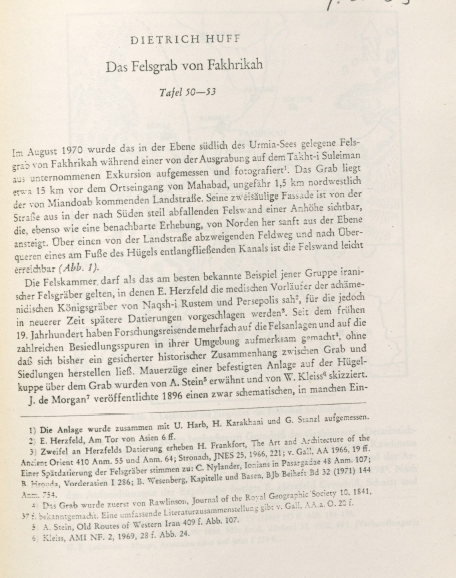 | Huff, Dietrich: Das Felsgrab von Fakhrikah. In: Istanbuler Mitteilungen, vol. 21, pp. 161-171, 1971. @article{nokey,
title = {Das Felsgrab von Fakhrikah},
author = {Dietrich Huff},
year = {1971},
date = {1971-00-00},
urldate = {1971-00-00},
journal = {Istanbuler Mitteilungen},
volume = {21},
pages = {161-171},
publisher = {Deutscher Verlag für Kunstwissenschaft},
keywords = {Architecture, West Azerbaijan},
pubstate = {published},
tppubtype = {article}
}
|